
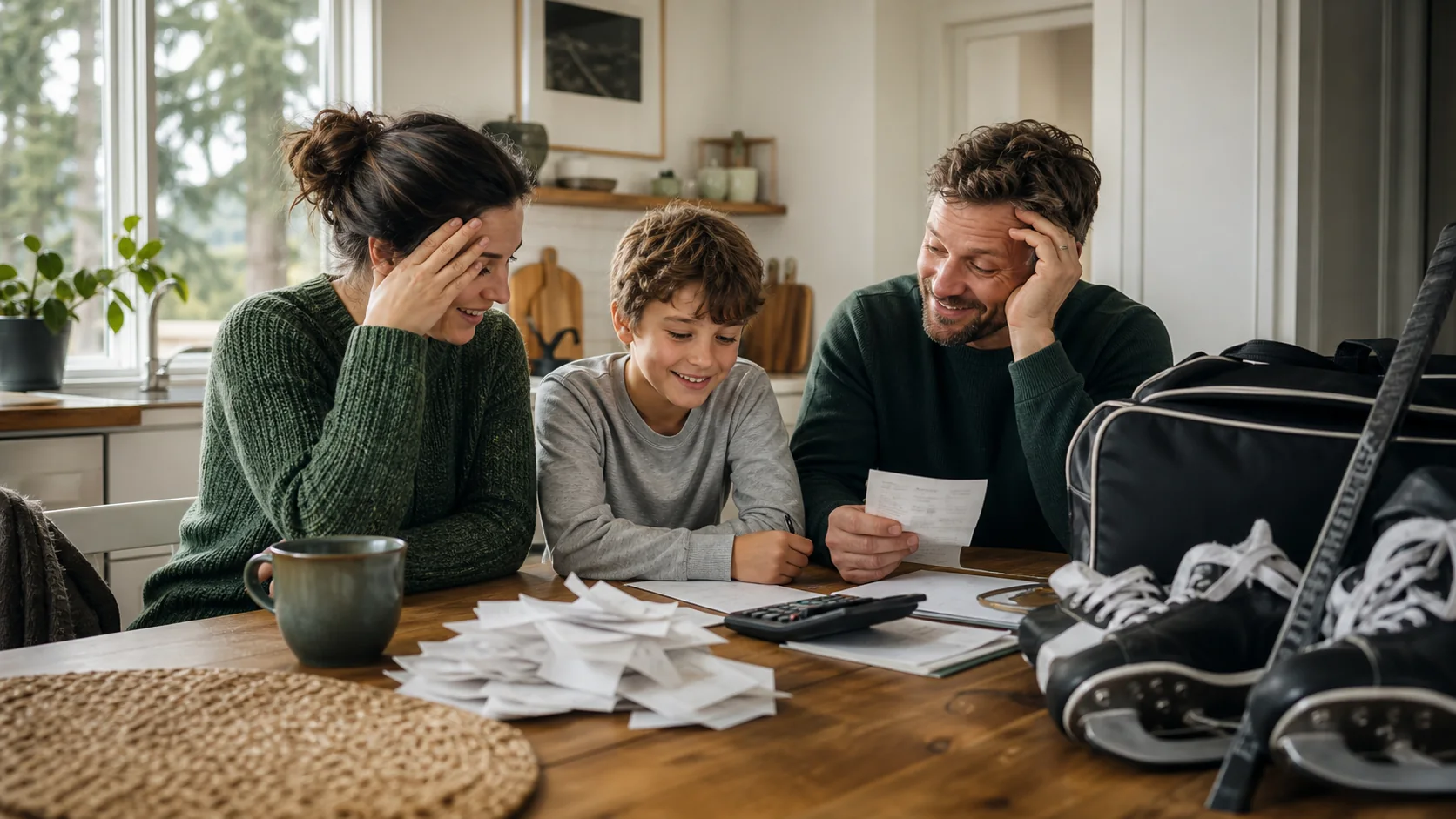
Hockey registration has a remarkable talent: it looks like the price of hockey right up until you pay it. Then the season introduces equipment, team fees, tournament hotels, sharpening, gas, snacks and a child who announces that both skates became too small sometime between Tuesday and Thursday. The goal of this guide is not to scare anyone away from the rink. It is to help families see the whole season before the whole season sees their credit card.
The honest answer: it depends, but not in a useless way
There is no single average cost that describes a U7 player borrowing beginner equipment, a U13 house player and a U15 rep player travelling to four tournaments. They all play hockey. Financially, they may as well be participating in three different sports.
A practical house-league planning range is roughly $1,500 to $3,000 for one child when registration, some equipment, routine rink purchases and local transportation are included. A family using borrowed or second-hand gear and doing little travel may spend less. A child who needs a full new setup may push higher.
Rep hockey begins with tryout and rep charges, then adds team fees and a larger travel calendar. Several thousand dollars is normal planning territory. A season with multiple hotel tournaments, extra development and frequent equipment replacement can move past $10,000. That upper end is possible, not mandatory—and it should never be treated as the admission price for being a serious player.
Registration is the cover charge
Registration generally pays for the organized season: association administration, insurance and governing fees, scheduled ice, officials, player development and other program costs that vary by association. It does not mean every cost from September through March has been wrapped into one thoughtful little invoice.
For 2026–27, Abbotsford Minor Hockey posts registration from $685 for U7 to $1,050 for U15 and U18. Chilliwack's regular returning-player fees run from $725 at U7 to $1,355 for U18 rep before the separate tryout and rep charges. Early registration can be cheaper; late registration can cost more and may come with a wait-list problem, which is a particularly expensive way to learn that emails marked ‘important’ were, in fact, important.
Read the entire registration page, not just the largest number in the table. Look for tryout charges, rep or carding fees, deposits, movement fees, late fees, payment deadlines and sibling or goalie discounts. Refundable deposits are not final costs when everything comes back, but they still affect the cash you need during the season.
- Base registration for the correct division
- Early, regular and late-registration dates
- Rep tryout and rep-player charges
- Jersey, pant-shell or equipment deposits
- Payment-plan rules and deadlines
- Sibling, goalie and new-player programs
Equipment has two prices: buying it and replacing it
A first set of hockey equipment is a serious purchase because there are many pieces and they all need to fit together. The second surprise is that children continue growing despite receiving no budget approval from the household finance committee.
You do not need top-tier equipment in every category. Fit, protection and comfort matter more than the word printed on the stick. Spend carefully on properly fitted skates and a current, undamaged helmet. Protective pieces can often be found through reputable used-equipment shops, association swaps and other hockey families, provided they are in safe condition and still fit correctly. Follow current certification and association requirements, especially for helmets and neck protection.
Build an equipment refresh line into every season. Some years it may be new socks and gloves. Other years your player wakes up three inches taller and the budget begins making the same expression as a goalie facing a two-on-none.
- Full first setup or beginner-program equipment
- Skate and helmet fitting
- Growth replacements during the season
- Stick replacement and a practical spare
- Base layers, socks, neck protection and athletic support
- Bag, bottle, skate guards, tape and spare laces
Meet the second fee: the team fee
After registration comes the team budget. This can cover tournaments, extra practices, development sessions, officials, team events, apparel, photos and other costs approved for that group. The amount can differ dramatically between house and rep teams—and between two teams at the same level.
Ask for a written budget early. Find out what the family payment covers, which fundraising is mandatory, whether fundraising reduces each player's amount or the whole team bill, and what happens when a planned tournament changes. ‘We usually do a few things’ is not a budget. It is the opening line of a future group-chat adventure.
Fundraising can lower the cash bill, but it still costs time. Bottle drives, raffles and concession shifts belong in the family budget even when no money leaves your account. Weekends are a currency too.
- Expected player contribution and payment dates
- Number and level of tournaments
- Extra ice or development sessions
- Mandatory fundraising and volunteer hours
- Team apparel, photos and social events
- Refund rules if plans change
Tournament travel is where the budget learns to skate
A tournament fee is paid by the team. A tournament weekend is paid by the family. Hotel rooms, fuel, parking, restaurant meals, sibling activities and the emergency purchase of whatever stayed at home all sit outside the registration total.
Estimate travel one weekend at a time. Use the likely hotel rate, number of nights, driving distance, parking and a realistic food amount. Do not budget every meal as groceries if experience suggests the family will be eating beside an arena in a town where the first game ends at 7:40 p.m.
Competitive hockey can add several travel weekends, and spring or tournament teams may add more. Before committing, ask for last season's approximate schedule and costs. Nobody can promise the exact calendar, but ‘some travel’ and ‘four hotels plus a ferry’ are financially different sentences.
Alternative leagues: same puck, dramatically different calculator
Families may also look at spring development, BC's HPL Hockey, independent academy leagues such as the JPHL or Hockey Super League, and sport-school programs that compete in the CSSHL. These are not simply house hockey with a nicer tracksuit. Some combine coaching, development, league events, apparel and school-day training; others leave administration, travel, education, transportation or housing outside the first number you see.
At the lighter end, Okanagan Hockey Group listed its six-week 2026 spring development program in Penticton at $950 including tax. That is a development program rather than a full winter season, but it shows how quickly spring hockey becomes a separate budget line—especially if a team also adds tournaments, uniforms and travel.
For BC families, HPL Hockey is a private development stream for younger players rather than a local minor-hockey association. HPL says its 2026–27 program will include more than 1,000 players from Grade 1 through Grade 7, with teams operating through separate program partners in the Lower Mainland, Okanagan, Central BC, Vancouver Island and Washington. Its league site does not publish one current universal player total, so the exact program quote matters.
For historical context only, a public 2023–24 package for one HPL 2012 team listed an $895 league-registration fee plus a $5,345 team fee—$6,240 plus tax before outside tournament travel and some apparel. That is not a 2026–27 price quote, but it shows why HPL should have its own several-thousand-dollar line in the family budget. Ask the specific HPL club for its current registration, team, tournament, travel, apparel and spring-program costs before accepting a roster spot.
For a full independent-league example, Silent Ice says JPHL pricing varies by hub but averages about $20,000 to $25,000. Its description says that games, league events, practices, an apparel package and certain team equipment are included, while administration fees are extra. Treat that as a planning marker, then get the exact written package from the specific hub. A league average cannot tell you whether your family is paying for a bus, a hotel or the privilege of discovering both later.
Sport-school academy hockey can move higher. Okanagan Hockey Academy's posted 2025–26 prospectus lists a $28,000 program fee plus GST and team-travel fees of $7,000 to $9,000 plus GST, depending on the team. That puts the two core lines at roughly $35,000 to $37,000 before a possible $9,500 billet fee, transportation, non-BC education charges, international fees or other family travel. It is a useful real-world example, not a price tag for every CSSHL program.
Hockey Super League fees are also set through individual academies and teams, so there is no honest single HSL number to print here. For HPL, HSL or any private program, ask for a written, all-season quote and compare the same categories. If the brochure says ‘all-in,’ ask whether all has met tournament hotels yet.
- Spring program: ice, off-ice training, tournaments, apparel and travel
- HPL or another private league: league registration, team fee, tournaments, travel, apparel and spring commitments
- Independent academy league: program fee, administration, team travel, equipment package and school arrangements
- Sport-school academy: tuition or program fee, team fee, education, transportation, billets and family travel
- Every pathway: deposits, taxes, refund rules, fundraising and what happens if the player leaves
Optional hockey is still optional
Private lessons, spring teams, summer camps, shooting pads, premium sticks and branded training gear can all be useful in the right situation. They are not proof that a family cares more, and skipping them is not proof that a player lacks commitment.
The hockey world can make optional spending feel strangely urgent. Another player has a new stick. A social-media clip promises a better stride. A camp has three spaces left, just like it had three spaces left yesterday. Pause and ask what problem the purchase is supposed to solve, whether the coach sees the same need and whether free practice, rest or regular play would do the job.
Set an optional-development amount before the season. When it is used, the answer becomes ‘not this year’ rather than a fresh household debate every Friday. This protects both the family budget and the child's sense that every hockey opportunity must be accepted immediately.
- Private skills and skating lessons
- Spring and summer hockey
- Camps, clinics and off-ice programs
- Premium sticks and frequent upgrades
- Home training equipment
- Team-branded clothing beyond required items
Spend less without making hockey miserable
Saving money works best when it is planned, not when every purchase becomes an emergency. Register during the lower-fee window, keep a running equipment-size list, watch association swaps and ask experienced families which items are worth buying new.
Buy for fit, not for the hope that a child will grow into equipment two seasons from now. Oversized protective gear can shift, restrict movement and create safety concerns. A properly fitted entry-level item is usually a better purchase than a premium item that does not fit.
For tournaments, share driving when appropriate, use hotel breakfast when it genuinely works, bring familiar snacks and plan one or two simple meals before leaving home. The goal is not to turn the weekend into an accounting retreat. It is to stop paying convenience prices for every single decision.
- Register before regular or late pricing begins
- Use reputable second-hand shops and association swaps
- Sell outgrown gear while it still has useful life
- Ask for the team budget before optional events are approved
- Pack tournament snacks, bottles and one easy meal plan
- Treat private training as a choice, not a default
Ask about financial help early—before deadlines stack up
Financial assistance exists because hockey costs are a genuine barrier, not because families failed a character test. Apply early, read the eligibility rules and ask your association which programs can be combined.
The Hockey Canada Foundation Assist Fund provides approved applicants with up to $500 toward registration at a sanctioned association. KidSport BC's Provincial Fund may provide eligible children with up to $400 per calendar year, while local chapters can set their own amounts. Jumpstart's 2026 Individual Child Grant can cover eligible registration and equipment costs up to $300 per child, subject to local availability and eligibility.
Some associations also operate local funds. Chilliwack Minor Hockey, for example, lists its own hockey fund and explains how it may work alongside third-party grants. Deadlines and available funding can change, so start before registration is due rather than after the family budget has already gone into overtime.
Find your family’s number before saying yes
Start with the association's posted charges, then add equipment, the expected team fee, each likely travel weekend, routine rink costs and an optional-development limit. Include refundable deposits in cash-flow planning and label them separately so they are not mistaken for money that vanished permanently into the arena ceiling.
Add a buffer for growth and schedule surprises. Then look at the total beside the family's time, transportation and sibling commitments. A season can be affordable on paper and still overwhelm a household when three weeknights and every second weekend are already spoken for.
The right hockey budget is not the biggest one a family can survive. It is the amount that lets the child play, the bills get paid and the adults still enjoy seeing the rink instead of quietly resenting its parking lot.
Save or print
Build your real youth-hockey season budget
- Base registration for the correct association and division
- Tryout, rep-player, movement and late-registration charges
- Refundable deposits needed during the season
- Expected team fee and payment schedule
- Mandatory fundraising and volunteer commitments
- First equipment setup or this year's replacement list
- Skate sharpening, tape, laces and routine rink supplies
- Tournament hotels, fuel, parking and meals
- Extra practices, camps or private training you choose to include
- Spring or summer hockey, if it is actually in the plan
- Independent-league or academy fees, including administration, school, team travel, transportation and billets
- A growth-spurt and broken-equipment buffer
- Grants, sibling discounts, goalie discounts and association assistance