Buying a hockey bag seems simple. There are really only a few choices: wheels or no wheels, then a couple of useful sizes. Somehow you can still end up with a bag so big your kid looks ready to move out—or one with straps so long it rides on their ankles and turns the walk to the dressing room into part of the training program. And if Dad ends up carrying it, he should at least have the decency to look embarrassed when the other hockey parents see him.
The quick parent answer
Check the bag dimensions against the size of the equipment your child already wears. The right bag holds the full setup without needing a wrestling match, but it is not so oversized that the equipment disappears into one damp, black cave.
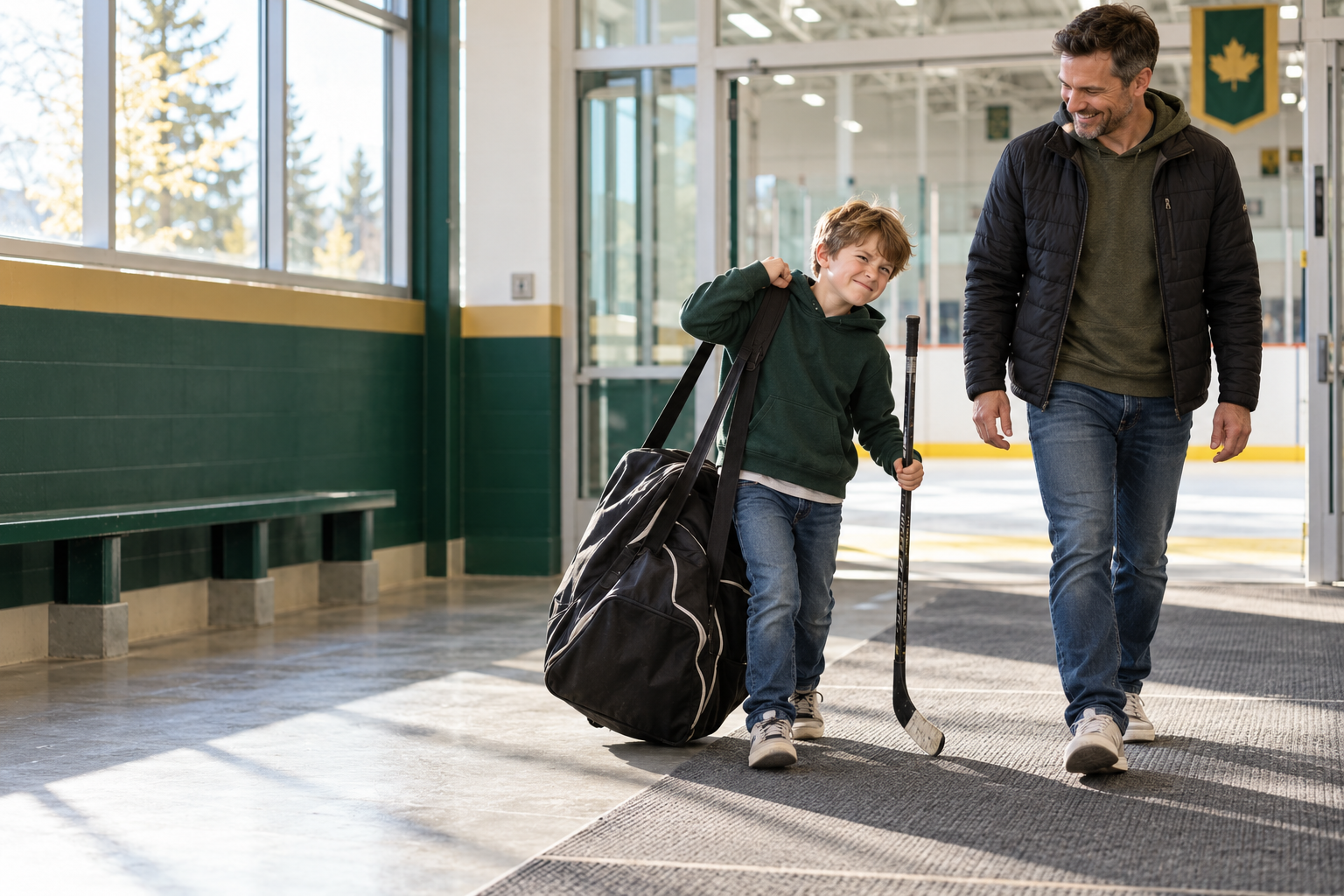
Most importantly, choose a bag the player can manage alone. Carrying your own equipment is a hockey rite of passage. It builds responsibility, becomes part of the routine and is generally expected around the rink. Parents can teach the packing system; the player carries the bag.
If a perfectly capable player walks into the arena carrying one stick while a parent follows behind with the bag, there will be judgment. Maybe nobody says it out loud. Maybe they do. Either way, the parent should feel just embarrassed enough to hand it back.
Bigger is not always better
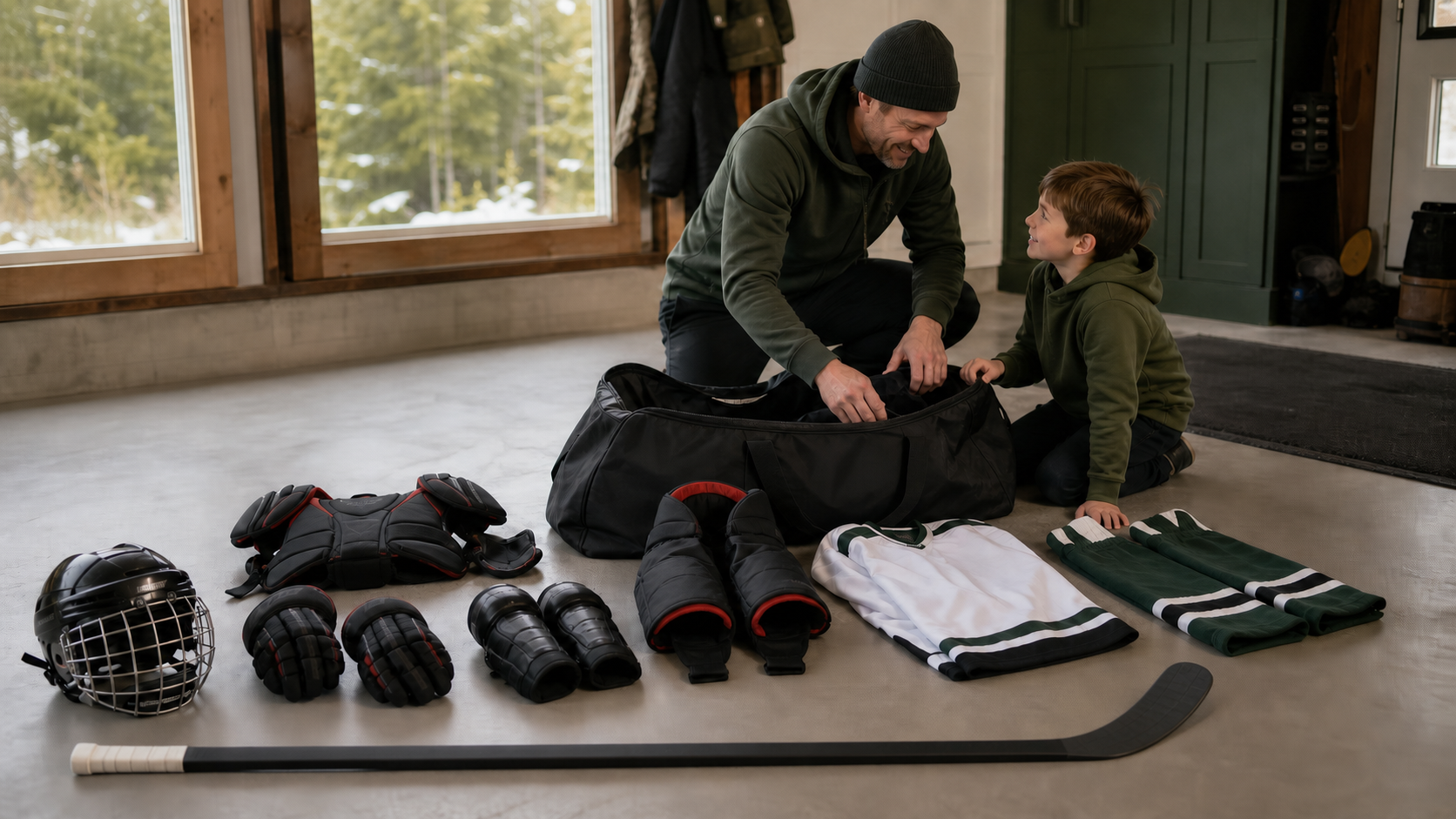
Bag labels are inconsistent, so trust actual dimensions more than the words youth, junior or senior. Lay out the shoulder pads, pants, helmet, gloves, elbow pads, shin pads and skates. The bag needs to hold that equipment without crushing the helmet or forcing the zipper shut with a knee on the lid.
A little extra space is useful for a towel and base layer. A huge bag gives the equipment room to slide to one end, makes the load harder for a child to control and invites half the dressing room to come home in it.
Kids grow, but you do not need to buy the hockey-bag equivalent of a studio apartment. Buy for the current equipment with reasonable breathing room. By the time a young player truly needs a senior-sized bag, the original zipper and handles may have already lived a full life.
The main decision: wheels or shoulder straps
A wheeled bag is excellent for long arena corridors, tournament hotels and younger players building up to a full carry bag. The tradeoff is more weight, a rigid base and wheels that are less impressive in snow, gravel and staircases.
A carry bag is lighter, simpler and easier to lift into a packed trunk. But check the handle drop against the child’s height. If the straps are too long, the bag hangs at calf or ankle level and bangs into every step.
Smooth hallways may favour wheels; stairs and snowy parking lots may favour a lighter carry bag. Either way, the player should be able to get it from the car to the dressing room without a parent taking over.
What survives the season—and the first flight
Most bags look tough while sitting empty under store lights. Travel tournaments expose the truth. Airline handling will find the weak zipper, unsupported seam or decorative handle that was never meant to lift a fully packed hockey bag.
Look for heavy fabric, reinforced stitching where the straps meet the bag, a strong full-length zipper and a base that does not feel thin or brittle. On wheeled bags, check how the wheel housing attaches to the body. Hard plastic corners and exposed wheel assemblies take the punishment first.
A travel bag does not need twelve pockets. It needs seams that stay closed when somebody grabs it from the wrong end. If the family expects to fly, use a luggage strap around the packed bag, remove loose external accessories and put identification inside as well as outside.
No soft hockey bag is indestructible, but there is a real difference between scuffs from baggage handling and a seam being torn open before the first tournament game.
Give everything a neighbourhood
Perfect bag organization will last approximately one practice. A repeatable rough system has a chance: skates at one end, helmet at the other, large pads in the middle and small clothing pieces together in a mesh pouch.
Put repair tape, spare laces and a small screwdriver in one zip pouch instead of letting them migrate to the bottom. Keep the water bottle out while drying, clean it after practice and return it once dry so it is not left on the kitchen counter for the next departure.
The child should do the final check. Parents can help build the routine, but learning where the equipment belongs is part of learning to manage the sport.
The bag needs to be emptied, even if it has twelve ventilation panels
Take out the base layer, socks, towel and anything obviously wet after every ice time. Open up the larger equipment and put it on a drying rack or another ventilated surface. Save the full wash for the day you are feeling heroic.
Our <a href='/blog/how-to-wash-hockey-gear-at-home/'>hockey-gear washing guide</a> covers what can go in the machine, what needs gentler cleaning and how to handle the bag itself. The <a href='/blog/best-hockey-gear-drying-racks-for-families/'>hockey drying-rack guide</a> handles the part where the garage stops smelling like the third period.
Measure first and keep the choice simple
Compare the published dimensions of current youth and junior bags at <a href='https://www.sourceforsports.ca/collections/hockey-bags'>Source for Sports</a>, <a href='https://www.sportchek.ca/en/cat/shop-by-sport/hockey/hockey-bags-DC2001027.html'>Sport Chek</a> or <a href='https://www.hockeylife.com/collections/hockey-bags'>Pro Hockey Life</a>. Measure the bag your child uses now or use the equipment checklist to estimate the space the current setup requires.
Check the zipper, reinforced strap attachment points, wheel housing and the listed handle length. The goal is straightforward: enough room for the gear, straps that work for the child’s height and construction that survives being carried by the player all season.
When the old bag has finished its last road trip
A broken zipper, torn handle, cracked wheel base or fabric that has separated around the seams is a better reason to replace a bag than a new colour release. Small tears can sometimes be repaired before they spread.
Also replace it when the equipment truly no longer fits or the player has outgrown the carrying system. If the bag still works, clean it, label it and keep using it. Hockey already provides enough ways to spend money.
Save or print
Youth hockey bag buying checklist
- Compare actual bag dimensions—not only youth or junior labels
- Use the current bag or equipment list to estimate the space required
- Check the handle drop against the child’s height
- Make sure a carry bag will clear the floor and ankles
- Choose wheels only if they suit the arenas and travel routine
- Check zipper strength and reinforced strap attachment points
- Inspect the wheel housing and base on wheeled bags
- Look for ventilation without assuming it replaces unpacking
- Confirm the bag fits the family vehicle
- Add the player's name and a parent phone number
- Make carrying and unpacking the bag part of the player’s routine